In the realm of artificial intelligence, the notion that a machine can teach itself is a fascinating concept, endlessly discussed and often misunderstood. While it’s common to imagine an AI tirelessly studying, analyzing data and uncovering profound insights in the blink of an eye, let’s debunk this widely held myth. AI does not educate itself the way humans do, it doesn’t possess innate curiosity or develop new strategies based on independent thought.
The teaching we refer to involves a sophisticated process of optimization, fine-tuning responses based on parameters and rules pre-set by humans. Our objective here is to break down the truth behind this captivating narrative and elucidate the actual mechanics guiding AI’s so-called learning. Let’s embark on an enlightening journey, distinguishing between the AI pop culture spectacle and its technical reality.
Tearing Down AI Learning Misconceptions
It remains a common belief that artificial intelligence has the ability to independently generate new understanding. Yet, this is far from reality. Artificial intelligence, contrary to folk wisdom, cannot simply sprout new knowledge or cultivate virgin ideas.
Rather, its capability pivots around the optimization of patterns within predefined datasets and algorithms. The optimization process, in essence, equates to a form of information filtration – a methodical refining procedure under human-installed parameters.
A parallel misconception paints AI as a conscious entity, one that harbors personal intent in its calculations. This portrayal, no less fallacious, skews the reality of AI’s function. The truth of the matter is, AI is no sentient being. There’s no consciousness at play, no intuition.
AI operates solely by statistical relationships and computational logic. It uses rigorous mathematical translations to convert raw data into usable patterns. It’s a mechanism, not a mind.
By coming to terms with these realities, we can better navigate the intrigiung, yet ultimately misleading mythology that surrounds artificial intelligence and its learning capabilities.
AI Learning Relies on Human Inputs
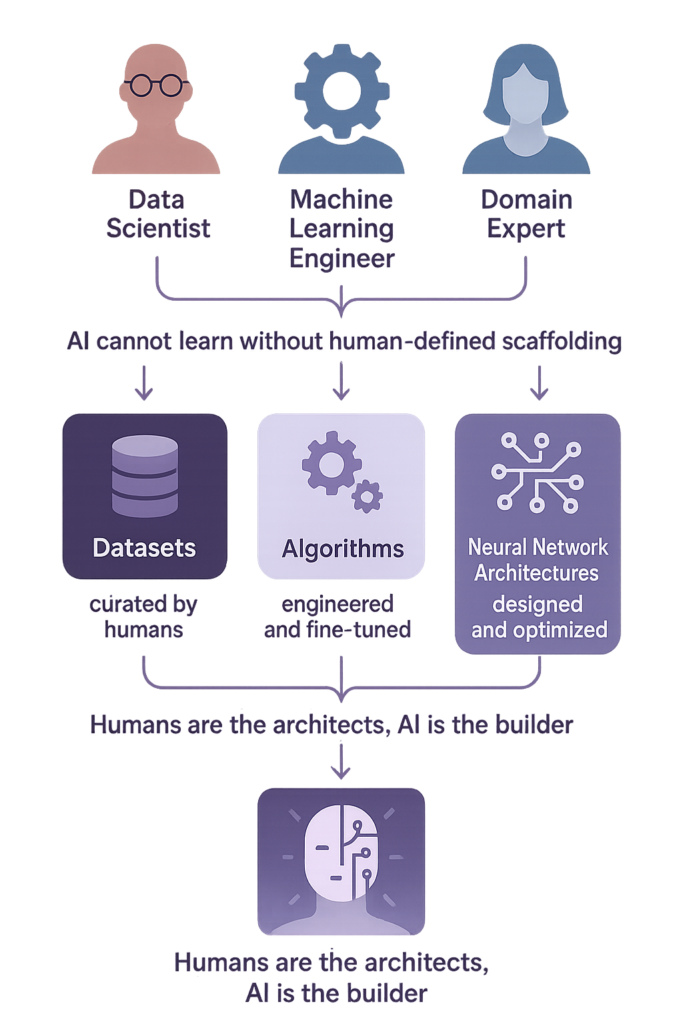
Just as a student can’t learn without a teacher, artificial intelligence can’t do without a guiding human hand. The idea that AI can educate itself autonomously is nothing more than a myth. Behind every algorithm that seemingly ‘learns’, you will find a human curator. Data scientists and machine learning engineers meticulously orchestrate AI learning processes by building concrete frameworks from which such systems draw their intelligence.
Consider datasets, algorithms, and neural network architectures. Without these foundations, an AI is a blank slate, unable to process or understand anything. These elements, curated and constructed by humans, serve as the textbooks and lesson plans for AI. Data scientists compile and organize datasets meticulously, preparing them for consumption by our machine learners.
Likewise, machine learning engineers design algorithms that guide AI’s data navigation. By setting the course, they teach AI how to study effectively, just as a human teacher would. In this case, think of algorithms as the route map, directing AI where it needs to focus.
Neural network architectures offer another layer of guidance. They resemble the paths in a dense forest, providing structure and making an unwieldy mass of information navigable. By defining these architectures, engineers establish the learning environment – the school, if you will – for AI.
Hence, what appears as autonomous learning is, in fact, a series of steps mapped out and executed under the watchful eye of its human creators. AI is ultimately a tool that operates within the confines of its programming. It’s the human minds behind the curtain who set the stage, initiate the learning process, and remain pivotal in advancing AI capabilities.
The Illusion of Autonomy: Reinforcement Learning in AI
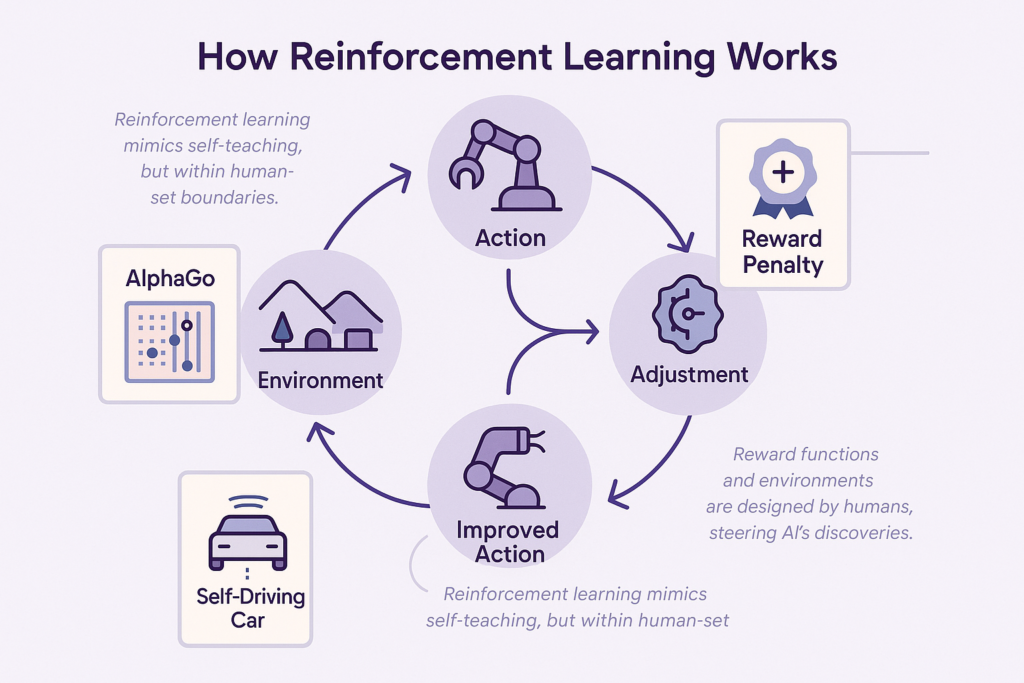
Let’s turn our attention to reinforcement learning, often hailed as the AI equivalent of ‘self-learning’. This machine learning training paradigm allows AI agents to learn through a trial and error method within a simulated environment.
They receive rewards for correct maneuvers and are penalized for missteps, gradually honing their understanding of optimal strategies and behaviors, much like a child learning to ride a bike. AlphaGo’s triumph over the world champion Go player, or self-driving cars navigating complex urban environments, are prime examples of this learning model in action.
But here’s the catch: even this seemingly autonomous learning process is still firmly leashed by human-defined conditions. Every reward or penalty, every rule of the virtual environments, even the initial parameters within which these AI agents operate, they are all pre-set by human designers. These designers, in essence, sketch the invisible lines defining what the AI agent can perceive, learn, and ‘discover.’
Thus, even in its most ‘autodidactic’ state, AI is still bound by a set of human-authored controls. It’s never truly teaching itself – it is learning the lessons and solving the puzzles we assign it. Never outside the range we delineate. It is a testament not to AI’s independence, but to the ingenuity of human oversight in AI.
The Real-World Ripple Effect: AI’s Learning Mechanisms Unveiled
- Ethical data sourcing and bias mitigation gain paramount significance, as the quality of data and the predispositions ingrained in it dictate what AI learns and how it evolves.
- Constant human oversight stays necessary for AI, just as periodic tests are vital for a student’s progress. For an AI model to stay relevant and accurate, frequent adjustments and improvements based on its outputs are critical.
- By understanding AI doesn’t replace human learning but rather enhances it, we see new possibilities. AI could take on monotonous, time-consuming tasks, freeing up human minds for creative and innovative ideas.
- Not all is rosy in the AI field. There’s a significant skill gap in AI development and maintenance. Much like finding qualified teachers in a growing economy, it’s proving challenging to find skilled AI experts.
- AI tools pave the way for speeding up human-led innovation and problem-solving. By automating routine tasks, they allow workforce to focus on complex matters, similar to a science lab boosting a budding scientist’s experiential learning.
Just as understanding how our human brain learns has shaped teaching methods and educational policies, comprehending the intricacies of AI’s learning processes could revolutionize our approach to AI development, management, and usage. Grasping the limitations and potentials of AI goes far beyond technical concerns; it questions how we perceive, interact with, and ultimately shape the intelligent tools of the future.
The Dance with the Machine: Human-guided AI Evolution
Peering into the future, what can we expect from AI’s maturation? Certainly, increased sophistication. Neural networks will dive deeper. AIs might even shed some of their reliance on human babysitters during learning phases.
But a Terminator-esque singularity, where machines turn into independent thinkers, remains an unlikely scenario. The reality is less dramatic. Despite its fancy coding, AI will always be a tool, a partner in our endeavors that needs human input to define its goals and constraints.
Artificial General Intelligence (AGI) may be the buzzword du jour, hinting at a future where machines can learn any human task. But rest assured, AI is far from achieving such a level of independence. We are not handing over the reigns. We’re simply giving AI a bigger say in how it can orchestrate its learning within the playground we’ve created for it.
Let’s be clear: ‘Can AI teach itself?’ is a question rooted in a fundamental misconception about AI’s abilities. Self-teaching, fully unaided cognitive development isn’t part of an AI’s skillset. It’s akin to asking if a calculator can start doing algebra on its own. A tempting thought, but not a realistic one.
In the foreseeable future, AI’s evolution will continue to be a duet – a dance between technology and human wisdom, each step guided by our flair for problem-solving, our deep-rooted ethics, and our vision of a digital landscape that serves we, the people.
Path to AI Literacy: Stay Informed and Engaged
1. Keep tabs on notable AI research institutions. Monitoring their studies and publications furnishes profound insights into the ongoing quests, breakthroughs, and discussions around artificial intelligence.
2. Make your voice heard in ethical AI dialogues. Contributing to such discussions, whether in a forum, workshop, or conference, enriches your perspective and fosters a culture of fairness and accountability.
3. Dive hands-on into the world of AI tools and platforms. Interacting with them isn’t just about learning their operation but also about grasping their underlying mechanics. Merely glancing over them doesn’t quite cut it.
4. Constantly feed your curiosity with educational resources that unravel the secrets of AI. These resources equip you not only with the theory but also help demystify the practical applications.
The last hurdle to cross in your quest is understanding whether or not AI can actually teach itself. This involves dissecting the underlying methodologies and data models rather than just floating on the surface.
Fortunately, this is where platforms like Edubrain step in, offering digestible explanations and tangible examples that help you fully comprehend the subtleties of AI learning processes. Remember, it’s not just about keeping abreast of AI evolution, but also actively participating in it.
Artificial Intelligence: Learning or Optimizing?
1. AI ‘learning’ is closer to optimization rather than comprehension, continuously fine-tuning performance based on a pre-existing framework.
2. AI greatly relies on human contribution. This includes not only the provision of data but also the design of algorithms and the setting up of architecture.
3. While reinforcement learning might give an impression of AI autonomy, remember that it is constrained by parameters set by humans.
4. Don’t ignore the ethical implications of AI. It’s critical to clearly understand what AI can truly do to responsibly envision and shape its future applications.
5. On a futuristic note, what we’re really looking at isn’t a world dominated by AI but one where humans and AI labor in synergy. Indeed, it’s less about AI independence, more about human-AI collaboration.
Demystify, Engage, Collaborate: The Trifecta of Realizing AI’s Promise
Gaining a clear understanding of AI’s mechanisms isn’t just conceptual hygiene; it’s a potent force when it comes to responsible development and usage. But let me underline: comprehending AI is only part of the equation. The value of such knowledge multiplies when you participate in the ongoing dialogue about how these systems stitch into our societal fabric. Refusing to shy away from the ethical, philosophical, or practical debates about AI’s role equips you with informed curiosity, shifting you from a passive observer into an active participant.
Distilling myths from facts within an AI context is one of the surest paths to responsibly unlock its potential. Unmasking biases, questioning its implications, and inspecting the mechanisms behind performance optimizations – these are all steps that empower you to harness the capabilities of artificial intelligence more effectively.
Let’s explore these frontiers together, inviting a future where AI is neither a mysterious black box nor an unquestioned authority but a tool that operates under our collective guidance. Let the true power of AI be no secret but a story we author together.