Just a couple of years ago, teachers worried that AI was another tool for students to sidestep the hard work of learning, particularly with the rise of essay-generating bots and online ‘homework helpers’. AI seemed a formidable weapon in the cheater’s arsenal.
Are we still in that same boat? Not necessarily. We can turn what might be seen as a threat into a classroom advantage. Say goodbye to the notion of AI as merely a concern of academic integrity. Instead, let’s welcome it as a tool to accelerate learning. This article aims to equip educators with strategies to encourage responsible AI use among students – beyond merely managing its risks.
The goal is not detection, but integration, a shift in perspective that views AI as a partner rather than an adversary in the learning journey. Education should go beyond mere ‘AI literacy’, helping students harness AI’s potential responsibly and effectively, fostering true digital citizens for the future. It’s not just about stemming the ‘AI Tsunami’, it’s about learning to ride the waves. Let’s delve into the structured approach that will transform AI from a source of concern to a pathway of empowerment in our classrooms.
The Folly of Ignorance in AI Education
Let’s face it, blindly banning AI in classrooms or wilfully ignoring its existence is a losing strategy. Why is it flawed, you ask? The reality is that students, tech-savvy as they are, will find a way to leverage AI, regardless of any bans. Such a head-in-the-sand approach leaves them unprepared and potentially unguided in ethical AI use. The right move then, lies not in preventing AI use, but rather in shaping it into a constructive and responsible educational practice.
Restricting AI’s presence in the curriculum significantly misses out on the chance to foster critical thinking. At the same time, it undermines the opportunity to prepare students with future-ready skills, as they navigate a world becoming increasingly reliant on artificial intelligence.
By incorporating AI into our classrooms, we have the chance to guide its use, creating a generation of learners who can adeptly and ethically wield this digital tool. It’s not merely about usage. It’s about responsible mastery – an essential skill for the future.
Four Tenets of Responsible AI Teaching
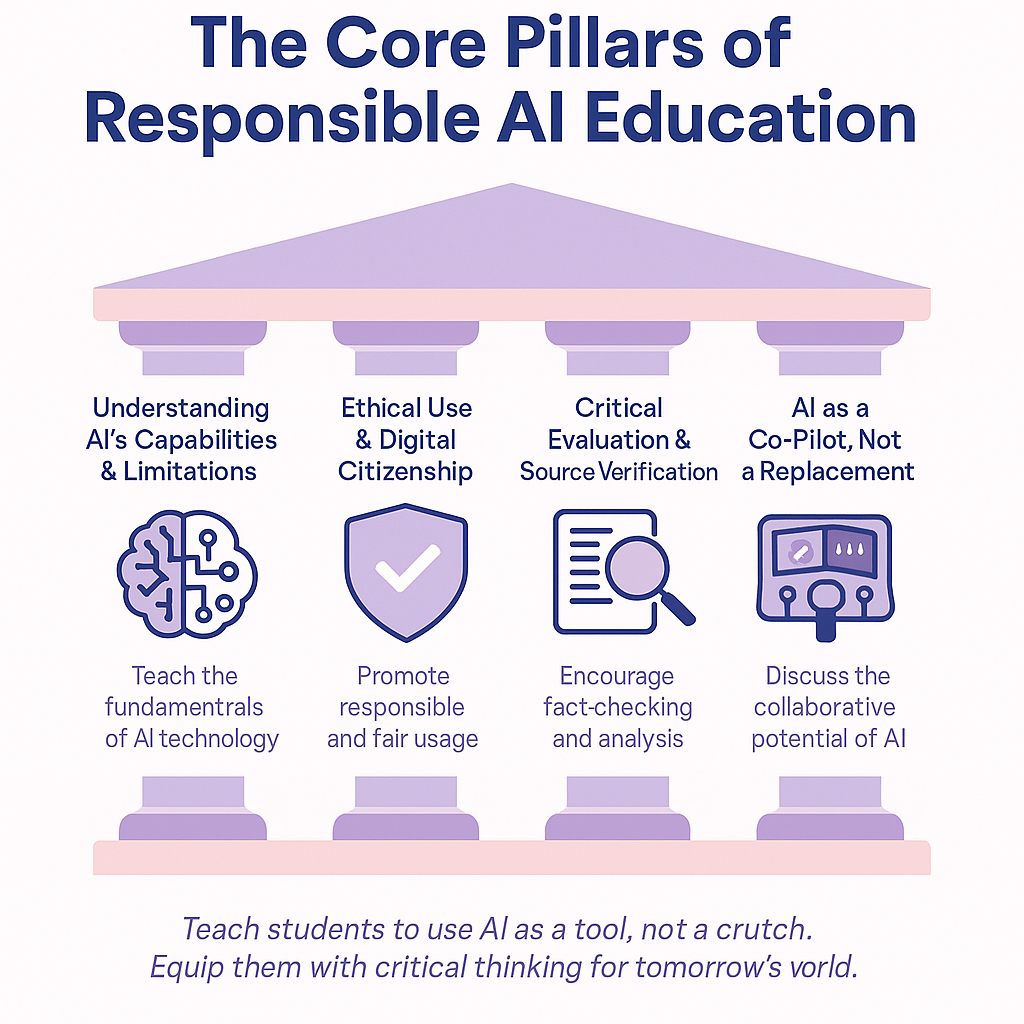
When it comes to AI in education, we can distill responsible integration into four core tenets.
1. Grasping AI’s Potential and Constraints: Students and teachers both need a solid understanding of what AI can accomplish — and what it can’t. This includes AI’s ability to process massive amounts of data and draw inferences, as well as its limitations in lacking emotional intelligence or creativity.
2. Adhering to Ethical Use and Digital Citizenship: Reiterating the importance of fairness, privacy, and intellectual property rights cannot be overstressed. AI shouldn’t justify breaching privacy norms or appropriating others’ work.
3. Keen Analysis and Fact Verification: AI-generated content can be misleading or false. Developing a critical mindset towards AI outcomes forms an essential step in incorporating AI in the classroom. Always encourage fact-checking.
4. Embracing AI as an Aid, Not a Substitute: Students need to strike that balance where AI aids them in their tasks without becoming a crutch that hampers creativity and original thinking. AI enhances human efforts, it doesn’t replace them.
Remember, the journey to responsible AI usage in education doesn’t have to be an uphill battle. By adhering to these principles, educators can shape a generation capable of harnessing AI’s beneficial aspects while steering clear of potential pitfalls.
AI as an Educational Assistant: The Shift in Classroom Integrations
With a proverbial wave of our hands, let’s dispel the notion of AI as merely a digital solution for students to beat homework. Instead, I propose a more symbiotic partnership – a shift from seeing AI as a ‘homework helper’ to a ‘learning partner’. The key to an effective integration lies in redesigning assignments – shifting from recall-based tasks, easily solved by AI, to complex problem-solving and creative endeavors that require combined human and AI input.
Seeing AI through this lens challenges students to use it as a tool to augment their critical thinking and creativity, rather than as an easy route to automate their assignments. There’s no denying that AI has a role to play in education. The task for educators is to ensure that this role is a constructive one, propelling students into a deeper and more responsible engagement with the material rather than sidelining them from the learning process. Remember, the goal of education isn’t automated response, but thoughtful action.
In the grand classroom of life, AI is becoming one of those essential classmates – a resource that doesn’t magically produce all the answers but helps you understand the problems better. We should be preparing our students for a future where collaboration with AI is a given, not an anomaly. It’s not about replacing human effort or thinking with AI, but about understanding how to leverage AI to augment human abilities. And that’s a lesson worth learning, don’t you think?
AI-Enhanced Assignment Characteristics
In an AI-integrated world, assignment design needs a fresh lens. Let’s ditch rote tasks, shifting to assignments that value critical thinking, personal reflection, and creativity. Got a notepad handy? Here are some characteristics to aim for:
1. Personal Reflection: Make space for individual thoughts. Remember, AI can’t reflect on life experiences.
2. Real-World Application: Assignments should solve real problems. AI shines brightest in practical contexts.
3. Multi-Modal Output: Break free from the essay rut. Let’s see dynamic presentations, digital graphics, AI-aided data visualizations…
4. Iterative Feedback: Integrate continuous review loops. Improvement comes in stages, not leaps.
5. Peer Collaboration: Foster team synergy. After all, two (or three, or four) minds are better than one, AI included.
6. Source Citation: Stress no-exceptions citation policies. Even if an AI whipped up the content.
7. Process Documentation: Encourage students to log their learning journey. It’s not just the final answer, but how they arrived there that matters.
Whew! A substantial list, but not an insurmountable one. Let’s dive into an AI-enhanced educational world, one reflective, practical assignment at a time.
AI in the Classroom: Tools and Guidelines for Responsible Use
Think of educational AI tools as digital partners for students and educators alike. These tools, when used constructively, can make learning and teaching more efficient and effective. To start, let’s explore a few and also discuss a few dos and don’ts.
- AI Writing Assistants: Supporting students in their writing process, these assistants can be powerful reminders to keep arguments clear and language polished. Use them to improve grammar and style, not to generate content.
- AI Image Generators: These tools bridge the creativity gap, translating text inputs into visual designs. Use them as starting points for creative projects, not as final products.
- AI Data Analysis Tools: By easing the process of analyzing data, these offer students an instant understanding of dynamic patterns and trends. Remember, though, they are tools for understanding, not replacements for critical thinking and interpretation.
- AI Coding Helpers: Instead of struggling with syntax errors, students can focus on logic and problem-solving. Yet, lean on them for debugging and learning, not to bypass the programming grind.
Now, shifting the spotlight to Edubrain: Think of it as a Swiss Army knife in the AI toolbox. It can help students parse complicated assignments or allow teachers to craft fresh practice problems. When faced with AI class solvers tempting students with an easy route, Edubrain presents a responsible alternative. It supports the learning journey, not furnish instant answers.
Edubrain also holds appeal for teachers, especially for those in search of AI tools for math. It can create diverse problem sets or provide step-by-step explanations for solutions, thus enhancing classroom teaching. Lastly, its bona-fide alternative status to ChatGPT for coding alternatives fosters robust, personalized feedback stretches.
Remember, AI’s ultimate power in education lies in its support role, never in its function as a shortcut. As we continue to integrate AI tools into our classrooms, we must stay focused on nurturing the human input that is central to all learning.
Grappling with Ethical Challenges: Bias, Plagiarism, and Privacy
As we’ve explored, AI holds immense potential in the educational realm. Yet, it’s imperative we don’t overlook the critical ethical considerations it brings. For starters, let’s discuss the elephant in the room: AI bias. It’s crucial to educate students on the reality of this bias, stemming from the fact that AI tools are often programmed with inherent human prejudices or inaccuracies. This education, however, is not only about recognition. Equally important is fostering a questioning attitude towards bias, empowering students to break the mould, rather than blindly accepting AI output.
Plagiarism also takes a new shape in this AI age. It goes beyond simple word-for-word copying; original thought and proper citation are still paramount. Convey to students: Whether it’s their brainchild or an AI’s suggestion, proper attribution shows respect towards intellectual property.
Lastly, let’s spotlight the role of data privacy. AI tools, as beneficial as they are, often demand students’ personal data. Before choosing a tool, ask: Is its data protection protocol robust? Do school policies guide data sharing and further use? Always keep privacy front and center of AI integration in your classroom. Using AI responsibly encompasses these ethics just as much as it involves beneficial learning outcomes.
Unpacking Misconceptions: AI in the School Setting
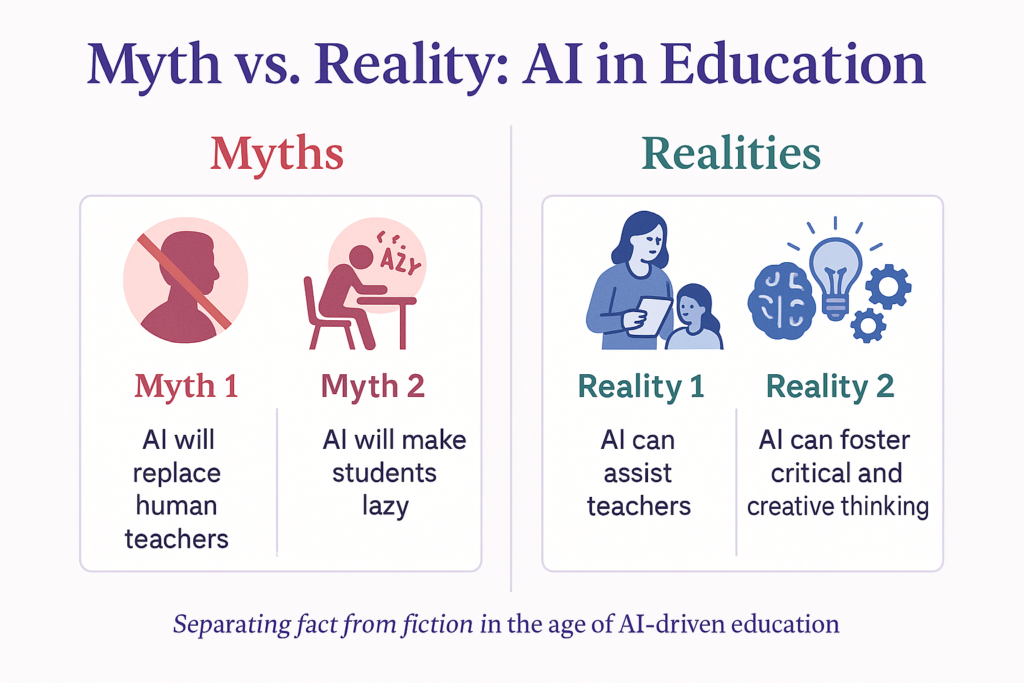
Let’s take a sidestep and debunk some myths surrounding AI in education. A concerning idea floating around is that AI could put teachers out of job. The truth uncovers a different reality. AI actually amplifies the role of the teacher, empowering them with informed insights to personalize learning and spur student growth. It’s a tool for educators, not a replacement.
Another common narrative suggests AI cultivates laziness by doing students’ work for them. On the contrary, AI redefines learning focus. It relieves the burden of rote tasks, freeing up students to explore critical thinking, problem-solving and creativity.
The third myth emphasizes that AI promotes plagiarism as students can easily lean on it to write papers. A factual rebuttal to this paints AI as a tool to scaffold learning, helping students develop their writing skills over time.
Understanding AI’s role is important. It’s not meant to serve as a shortcut or a crutch. It’s there to transform teaching methodologies and learning experiences.
Embracing Future Technologies: Fostering AI-literate Students
Let’s mull over this for a moment: The AI revolution isn’t just coming, it’s already here, reshaping the fabric of our lives, our workspaces, and yes, our classrooms. As responsible educators, we can’t bury our heads in the sand or treat AI as a threat. In fact, our mission evolves now; transforming this digital giant from a perceived threat into a trustworthy teaching comrade.
The era we are plunging into demands we arm our students with savvy critical thinking, nudging them to employ AI ethically and responsibly. Enough preaching – educators worldwide, it’s time to roll up our sleeves and dive headfirst into the dynamic world of AI, harnessing its power for a wholesome, productive learning experience. As we stride towards the future, let’s ensure our students become not just users, but masters of AI. The spark of transformation begins with us.
The Road Ahead: Prioritizing Ethical AI Education
Restating our primary idea, teaching students to responsibly use AI isn’t just a passing trend – it is a necessity. Far from speculating ‘if’ we should teach AI, we must focus squarely on the ‘how’. The unfolding potential of AI fuels human creativity and learning beyond imagination, but only when tethered to ethical considerations.
We hold the key to a digitally informed, ethical future, and it starts in the classroom. From not just AI ‘users’, let’s shape our students into thoughtful AI masters. Let the AI revolution begin.